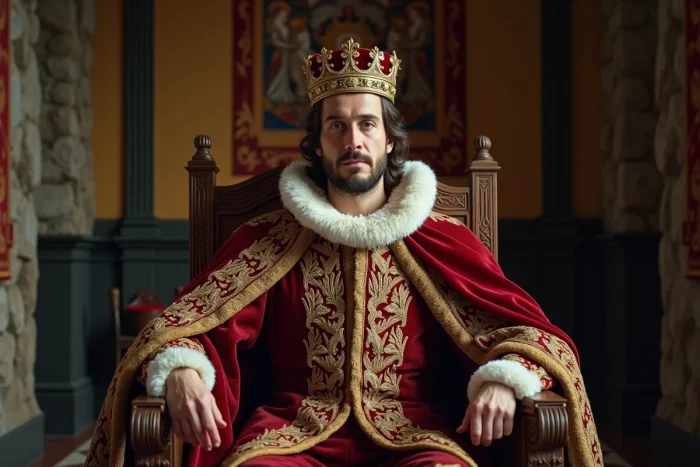
Charles X never signed his abdication with the hand that held the scepter, but with his left hand, to make it legally questionable. The Salic law excluded heirs who were closer by blood, in favor of a contested male purity dating back to the Middle Ages.
Ephemeral reigns have disrupted the dynastic order, while some monarchs ruled without ever being crowned in Reims. Successions have not always adhered to the direct line, oscillating between open conflicts and unexpected compromises.
Understanding the legacy of the kings of France: dynasties, symbols, and influences
Nothing has ever been simple or linear in the history of the kings of France. Successively rivals and allies, Merovingians, Carolingians, and then Capetians have shaped the kingdom through pacts, battles, and strategies. The Basilica of Saint-Denis says a lot: it is much more than a necropolis; it is the matrix of a sacred legitimacy, where dynasties seek their anchor. At the other end of the spectrum, the splendor of Versailles illustrates the birth of a centralized power, envisioned by Louis XIV to tame the nobility and embody the State. The châteaux of the Loire, for their part, testify to the shift from feudalism to a monarchy where art and the Renaissance take precedence over the archaic nature of fortresses.
The monarchs did not only leave their names in books: they imposed powerful symbols, from the fleur-de-lis to the scepter, including the crown. These attributes are not mere ornaments; they reflect the patient invention of a national mythology, where divine authority, affirmed by the coronation in Reims, coexists with human ambitions. The Middle Ages saw the establishment of this principle, while the Renaissance promoted the figure of the sovereign as protector of the arts and letters, extending his influence well beyond the kingdom’s borders.
To grasp the full complexity of this history, the list of kings of France offers a clear thread: each reign shapes, dismantles, or rebuilds the State, at the pace of wars, alliances, and reforms. The shadow of these figures still looms over our institutions and feeds a collective imagination that draws from the past to better understand the present.
What are the major reigns that shaped the history of the kingdom?
The fabric of France is woven through a few significant reigns, true turning points in national history. Louis XIV, the Sun King, stands out as an essential reference: seventy-two years of reign, Versailles established as an emblem, centralization pushed to the extreme, and the flourishing of culture and the arts. His mark remains indelible.
The Renaissance bears the imprint of François Ier. He attracts Leonardo da Vinci, makes Chambord a showcase, opens France to humanism, and positions himself as a rival to neighboring powers. Further back, in the Middle Ages, Philippe Auguste pushes back the borders, enlarges the royal domain, and stands up against England. Saint Louis embodies justice and piety, goes on a crusade, and leaves a model of a Christian king. Others, like Henri IV or Charles VII, illustrate the monarchy’s ability to survive the Wars of Religion or defeat, thanks to bold choices or the support of figures like Joan of Arc.
In the shadow of kings, some queens play a decisive role. Here are a few revealing examples:
- Aliénor d’Aquitaine shapes the medieval aristocracy through her culture and political influence.
- Catherine de Médicis maneuvers in a climate of tensions and dramas, trying to preserve the dynasty.
- Marie Stuart and Marie de Médicis weather the storms, oscillating between alliances and rivalries.
Several key events allow us to measure the impact of these reigns on collective memory:
- Massacre of Saint Bartholomew: a bloody episode of Charles IX’s reign, a symptom of the country’s religious fractures.
- Louis XVI and the Revolution: the monarchy collapses under the guillotine, marking the definitive break with the Ancien Régime.
The complete list of kings of France traces the thread of a rich history, where each sovereign, each crisis, each decision leaves a unique mark on the identity of the kingdom.

The complete list of kings of France and their remarkable journeys
The kingdom of France spans over thirteen centuries, carried by figures that school and national memory have never forgotten. From Clovis to Louis XVI, the complete list of kings of France traverses the dynasties: Merovingians, builders of the first kingdoms; Carolingians, then Capetians, who establish stability. Each leaves his mark, whether through war, diplomacy, or flair. Philippe Auguste redraws the map of the kingdom, strengthening his authority at the expense of the feudal lords. Saint Louis dies on a crusade, leaving behind a model of justice and piety, still cited as an example.
Several sovereigns embody an era in themselves. Here are a few who have marked the destiny of France:
- François Ier: monarch of the Renaissance, he makes his court a hub of artistic and intellectual innovation, notably with Leonardo da Vinci by his side.
- Henri IV: architect of peace, he issues the Edict of Nantes and revives Paris after decades of religious turmoil.
- Louis XIV: the Sun King makes Versailles the center of French power, shining through magnificence and strength.
- Louis XVI: the last monarch of the Ancien Régime, he confronts the Revolution and ends up on the scaffold, a symbol of an irreversible break.
The chronology of the kings of France is read in the stone of the Basilica of Saint-Denis, in the avenues of Versailles, or through the châteaux of the Loire. Each era, Middle Ages, Renaissance, modern times, sees the passage of sovereigns whose choices shape the history of France. The names of Charles VII, Louis XIII, Henri II, Charles VIII are inscribed in this abundant narrative, where power is transmitted, contested, and adapted. From generation to generation, the kingdom has transformed, weaving an indelible memory that continues to nourish the debate and the perspective we have on our past. The crown has extinguished, but history has never ceased to fascinate.