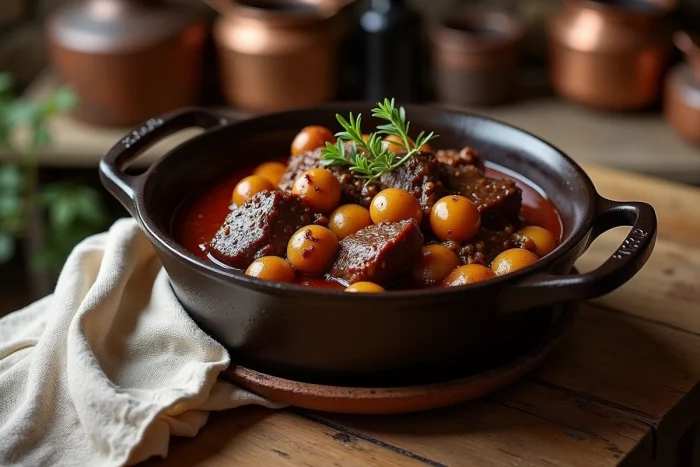
Boeuf bourguignon and carbonade flamande share the same principle, that of slow braising beef in an alcoholic liquid. The resemblance stops there. The cooking liquid, the herbs, the garnish, and even the final texture diverge to the point of producing two dishes with opposing flavor profiles.
Comparing these two traditional recipes is akin to measuring what red wine and brown beer do to the same piece of meat, and what each terroir adds to the pot.
Comparison table: boeuf bourguignon vs carbonade flamande
| Criterion | Boeuf bourguignon | Carbonade flamande |
|---|---|---|
| Cooking liquid | Red wine (Burgundy) | Brown beer |
| Region of origin | Burgundy, France | Flanders (France/Belgium) |
| Main herbs | Bouquet garni, garlic, onions | Caramelized onions, mustard, gingerbread |
| Classic garnish | Lardons, mushrooms, carrots, pearl onions | Layered onions, mustard spread on bread |
| Sauce profile | Tannic, round, slightly acidic | Sweet-bitter, malty, thicker |
| Typical accompaniment | Steamed potatoes, tagliatelle | Fries, potatoes |
| Iron content | High (braised meat) | Higher due to the malt in brown beer (source INRAE) |
This table summarizes the structural differences between the two recipes. To delve deeper into the difference between boeuf bourguignon and carbonade flamande, one must examine what each cooking liquid brings to the meat and sauce.
Red wine vs brown beer: how the cooking liquid changes the sauce
Boeuf bourguignon derives its depth from red wine. The tannins in Burgundy react with the collagen in the meat during braising, producing a sauce that is both silky and slightly astringent. The reduction concentrates the fruity aromas and gives that characteristic garnet color.
The carbonade flamande takes a radically different path. The brown beer brings notes of caramel and roasted malt. The residual sugar from the beer, combined with the long-caramelized onions, creates a thick sauce with a sweet-bitter character that red wine cannot replicate.
A comparative analysis by INRAE on the nutritional profiles of traditional French stews shows that carbonade flamande has a higher iron content due to the malt in brown beer. The red wine in the bourguignon provides polyphenols, but the mineral profile differs.
The role of bread and mustard in carbonade
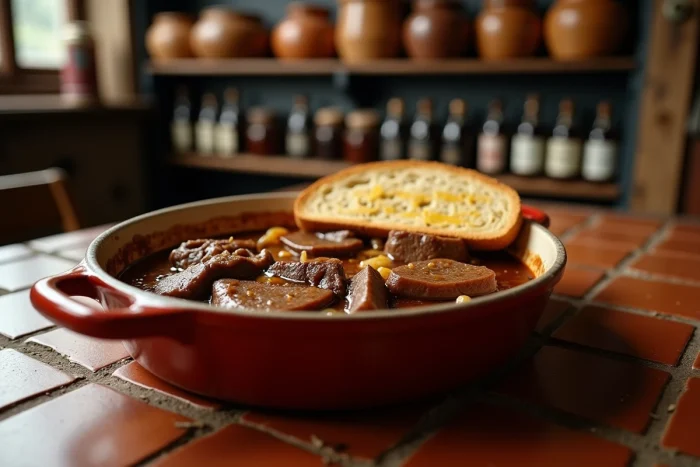
The carbonade flamande uses slices of bread covered with mustard, placed on the meat before braising. This bread dissolves during cooking and naturally thickens the sauce without adding starch. The bourguignon, on the other hand, achieves its consistency through the reduction of wine and sometimes a roux at the beginning of cooking.
This technical difference explains why the sauce of the carbonade has a denser body, almost coating, while that of the bourguignon remains more fluid and shiny.
Carbonade flamande and boeuf bourguignon in a low-carb version
Adapting these two traditional recipes to a low-carb diet poses distinct challenges related to the very nature of their ingredients.
For boeuf bourguignon, the transition to low-carb is relatively simple. The classic recipe contains few carbohydrates: meat, red wine (whose sugar reduces during cooking), lardons, mushrooms, onions. Simply replacing the accompanying potatoes with roasted celery root or mashed cauliflower yields a compatible dish.
The carbonade flamande presents a more serious obstacle. Three of its signature components contribute significant carbohydrates:
- Brown beer contains residual sugars from the malt, even after reduction. Replacing part of the volume with a rich beef broth and using only a splash of beer allows for reducing carbohydrates without losing malty aromas.
- The mustard-spread bread, which serves as a natural thickener, can be substituted with ground flaxseeds mixed with strong mustard. The melting texture of the sauce suffers slightly, but the binding remains adequate.
- Caramelized onions, which represent a significant portion of the total sugar in the dish. Reducing their quantity by a third and compensating with shallots (less sweet) preserves the aromatic base.
In both cases, the melting texture of the meat does not depend on carbohydrates but on collagen. A long, low-temperature braise, whether in a traditional pot or a modern slow cooker, produces the same characteristic shredding regardless of the sauce.
Slow cooker and traditional cooking: impact on the final result
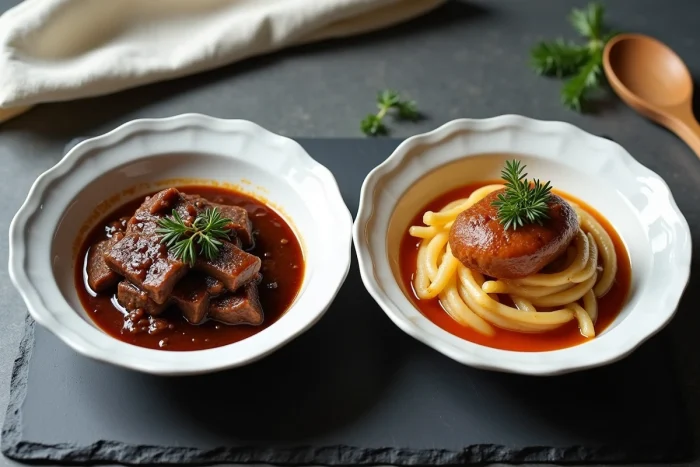
Flemish chefs interviewed by L’Hôtellerie Restauration have reported since 2024 a marked preference for the slow cooker in preparing carbonade flamande. The prolonged low-temperature cooking intensifies the aromas of brown beer and caramel without the risk of drying out, and without the supervision that a pot on low heat requires.
Boeuf bourguignon also benefits from slow cooking, but the Burgundian tradition emphasizes the initial browning of the meat pieces over high heat. This Maillard step, performed before braising, adds grilled notes that the slow cooker alone does not produce.
Which method for which dish
The carbonade flamande gains depth with entirely slow-cooked preparation: its onions completely melt, and the beer infuses into every fiber. The bourguignon, on the other hand, benefits from a hybrid approach (searing in a pot then transferring to a slow cooker) to combine caramelized crust and prolonged tenderness.
Appellation and protection: Belgian regulation of 2025
Since March 2025, a Belgian royal decree requires restaurants labeled “Authentique Flandre” to use exclusively beers protected by an appellation of origin for their carbonades flamandes. This measure aims to preserve the cultural identity of the dish against versions using industrial beers unrelated to the Flemish terroir.
Boeuf bourguignon does not have equivalent protection in France, although the use of Burgundy wine remains a recognized marker of authenticity in French gastronomy. This regulatory asymmetry reflects different approaches to protecting culinary heritage on either side of the border.
The choice between these two dishes relies less on a hierarchy of quality than on a preference for the tannic profile of red wine or the malty character of brown beer. The beef, braised for a long time in both cases, achieves comparable tenderness. It is the sauce that makes all the difference, and it is the sauce that one truly chooses when deciding between a carbonade and a bourguignon.