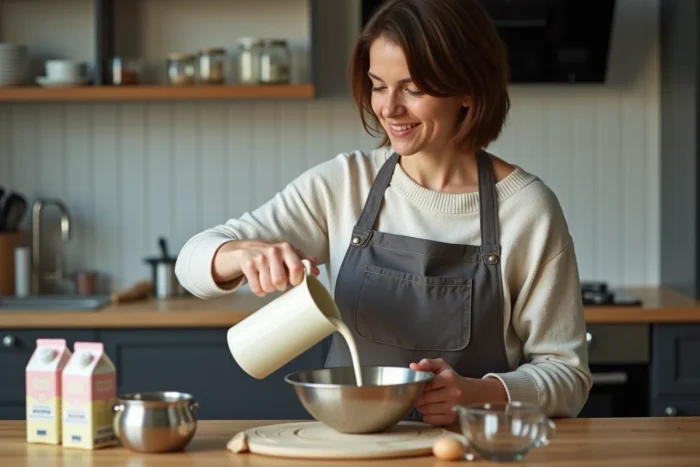
The density of liquid cream varies according to its fat content, which complicates direct conversions between volume and weight. One centiliter of whole liquid cream does not weigh exactly the same as one centiliter of reduced-fat cream.
To obtain a reliable measurement, one must rely on average values or the density indicated by the manufacturer. Ignoring this difference can distort a recipe, especially when precision is required. Conversion tools and equivalence tables serve as a guide to avoid common mistakes.
Why the conversion between centiliters and grams of liquid cream is not so straightforward
Converting from centiliters to grams for liquid cream seems straightforward, but the reality requires nuance. It is not a simple equality like with water, where each centiliter weighs one gram. Here, density governs and denies simplicity. Depending on whether the cream is light or whole, the mass for the same volume can vary significantly.
The composition of the cream dictates everything: a classic heavy cream, rich in fat, will always be heavier than a lighter version at the same volume. Forgetting this detail risks ruining a whipped cream or ending up with a sauce that is too runny. Manufacturers do not impose any uniform rules; it is common to read on some packaging “1 liter = 970 grams,” but elsewhere the value differs, depending on the brand or product. Before converting 40 cl of liquid cream into grams, it is better to check the small print from the manufacturer or refer to resources like “The weight of liquids: what 40 cl represents in grams – Gourmet Galopin.”
Several parameters influence the volume/weight correspondence, and it is better to take them into account:
- Fat content: a richer cream will naturally be denser.
- Temperature: density changes slightly depending on whether the cream comes straight from the fridge or has been at room temperature for a while.
- Industrial stabilization: some additives thicken or alter the texture, impacting the mass at equal volume.
As we can see, converting centiliters and grams for liquid cream requires attention and method. There is no question of relying on automatism: each recipe demands its own verification, or else the target may be missed.
40 cl of liquid cream: how many grams depending on the density and type of cream?
To convert 40 cl of liquid cream into grams, density remains key. Water serves as an easy reference (1 cl = 10 g), but liquid cream is below that: a liter rarely weighs a kilogram. A classic whole cream, favored for desserts or sauces, yields about 388 grams for 40 centiliters. This difference is explained by the proportion of fat, which weighs down the scale.
The nature of the cream significantly influences the final result. A lighter version, lower in lipids, comes down to about 380 g for 40 cl. Conversely, a thick or enriched cream can approach 400 grams. This is a detail that is not trivial, as it affects the texture of dishes and the success of a somewhat technical preparation.
Some professionals rely on tables to measure accurately and avoid unpleasant surprises. This table provides an overview of the most common equivalences:
| Type of cream | Volume (cl) | Mass (g) |
|---|---|---|
| Whole liquid cream | 40 | ~388 |
| Light liquid cream | 40 | ~380 |
| Thick cream | 40 | ~400 |
To refine the conversion, it is useful to take a look at the packaging: some manufacturers indicate the weight for 100 ml or the precise density. Comparing with water or milk, whose density is around 1, helps better understand the difference. In cooking, converting from centiliters to grams for liquid cream therefore requires rigor, with each ingredient calling for its own adjustment for a flawless recipe.
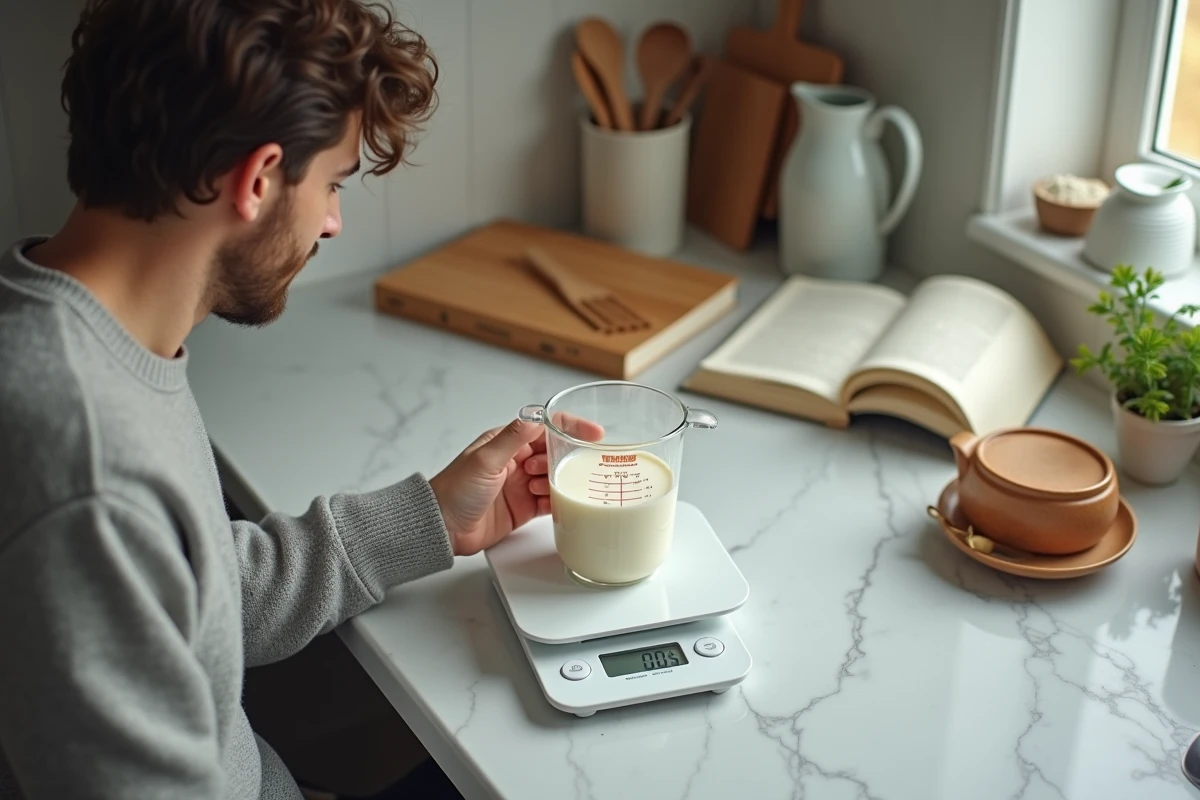
Practical tips for measuring cream without a scale or measuring cup
One does not always have a scale or measuring cup on hand. Measuring 40 cl of liquid cream in this context requires ingenuity, but there are simple methods to get by without sacrificing precision.
Everyday utensils often prove to be much more useful than one might think. A standard tablespoon holds about 15 ml of liquid: for 40 cl, you will need just under 27 tablespoons. A classic bowl, with its 250 ml, can be filled to just over a third to get close to 40 cl. As for the mug, it often holds 200 ml; two full mugs are enough to reach the desired volume.
- 1 bowl of 250 ml ≈ 25 cl
- 1 standard mug ≈ 20 cl
- 1 tablespoon ≈ 1.5 cl
Also, look at food packaging. Cream cartons sometimes display a measurement or specify their total volume, allowing you to pour the amount by eye, without any other tools. Milk or juice bottles, often graduated, can also be used for quick dosing.
For those following a recipe on their smartphone or tablet, many cooking apps offer a built-in converter. They take into account the specific density of the ingredient and facilitate the conversion between centiliters and grams without dedicated equipment. Gradually, the habit of using these references builds, and it becomes natural to measure liquid cream without ever missing the mark.
In the kitchen, conversion is never just a simple calculation. With each precise action, it is the promise of a successful dish, or the small margin of error that tips the result. Measuring liquid cream is about choosing accuracy and letting the magic happen without a false note.