Gardeners who venture with Japanese horsetail quickly learn what to expect: here, the rapid growth leaves no room for improvisation. Cutting at any time exposes the plant to weakening or, worse, illness. This perennial does not forgive calendar mistakes.
Everyone has their method: some wait for the complete maturity of the fertile stems to intervene, while others prefer to act just after flowering to keep the plant in line. The timing and method have an immediate impact on the silhouette of Equisetum japonicum and its long-term health.
Why pruning Japanese horsetail makes all the difference in its care
It’s hard to resist the almost geometric appearance of Japanese horsetail, this aquatic plant that adds dimension to the edges of a pond or terrace. However, behind this vertical stance lies a growth force that demands respect. This is where pruning makes perfect sense.
The key is to accompany the plant’s rhythm. Waiting too long results in brittle stems, tired foliage, and the risk of seeing the plant lose its splendor. Acting too early weakens the regrowth significantly. Regular observation of the foliage, this patient attention from the gardener, makes all the difference: a targeted intervention at the right time, and the horsetail integrates perfectly into the decor without ever overwhelming it.
For those who hesitate about when and how to prune Japanese horsetail, there are precise and reliable resources, such as those from Loisiragri, that shed light on the diversity of varieties and the best practices to adopt. The goal remains the same: to channel vigor and preserve elegance. Pruning with precision means choosing between an overrun patch and a perfectly controlled graphic touch.
When to intervene? Signs that indicate it’s time to prune
Nothing replaces the eye of the attentive gardener when it comes to deciding the right time to prune Japanese horsetail. Its cycle imposes its rules: spring and early autumn are the most favorable periods for effective intervention.
Several elements betray the need for pruning: the appearance of dry stems, tips losing their luster, or a density that prevents air from circulating well. These signals, sometimes discreet, are nonetheless decisive. As soon as they manifest, it becomes urgent to remove the tired parts before they promote moisture stagnation and the onset of diseases.
In a patch, it’s best to avoid letting dead stems accumulate. Regular pruning not only keeps the plant in shape but also prepares for multiplication, especially during rhizome division. Waiting for growth to restart in spring to cut what suffered through winter, or making a clean cut in autumn to prepare for dormancy: that’s the rhythm to maintain.
Well-managed, this routine ensures Japanese horsetail a constant vigor and a balanced presence, season after season, in any Japanese-inspired garden.
Practical tips for successful pruning and keeping Japanese horsetail in top shape
Precise gestures and regular rhythm
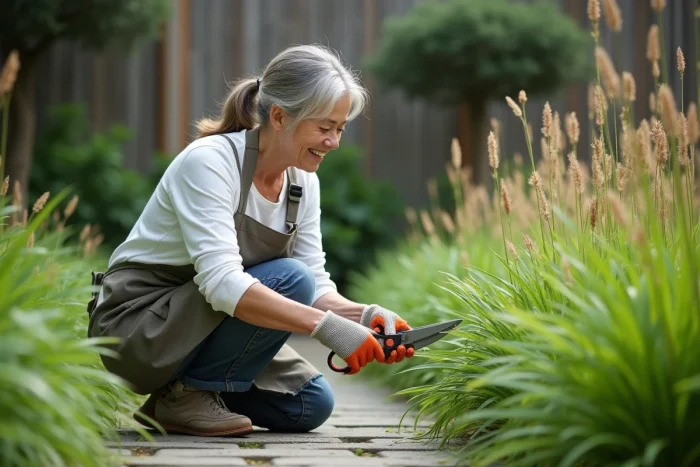
To keep Japanese horsetail in good health, the essential thing is to cut cleanly at the base of stems showing signs of weakness or aging. A well-disinfected pruner makes all the difference. Never cut flush with the ground: always leave a few centimeters to preserve the rhizomes below the surface. This gesture stimulates regrowth and limits the appearance of diseases while ensuring dense and elegant foliage.
Mastering development: avoiding invasion
Japanese horsetail tends to spread uncontrollably as soon as moisture and drainage are present. Regularly monitor the clumps, especially if they border a water point or occupy a pot. In the ground, an anti-rhizome barrier is highly recommended to keep control over expansion. In pots, pay particular attention to drainage and avoid water accumulation in the saucer, lest the roots suffer.
To facilitate management throughout the year, here are some gestures to adopt:
- Cut back the stems at the end of winter or at the beginning of spring.
- Remove browned parts without delay in autumn.
- Consider renewing the substrate every two to three years to maintain the plant’s vigor.
The soil also plays a key role. Choose a well-drained substrate rich in organic matter. A small application of fertilizer in spring is enough to support growth without ever rushing it. For pots, ensure that excess water drains properly. Regular monitoring and controlled pruning allow Japanese horsetail to fully express its graphic potential and become an asset in a balanced garden, without ever turning into an impossible adversary to tame.
Throughout the seasons, the silhouette of Japanese horsetail changes, but its visual impact remains intact, provided you keep control over its development. A well-maintained garden, a plant at the peak of its form: the promise of a corner of nature where order and vigor are never a matter of chance.