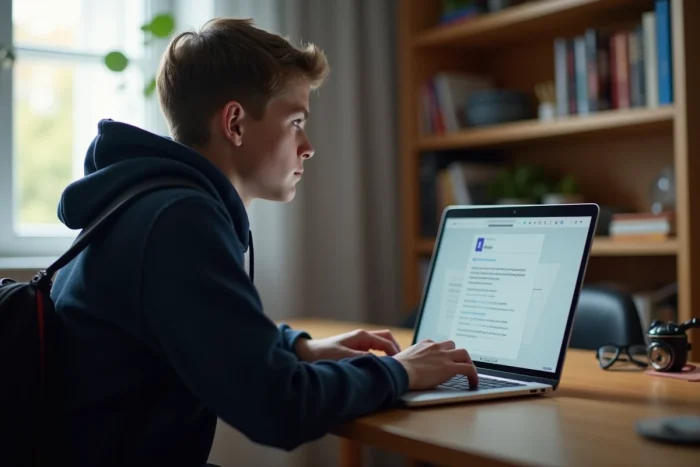
The procedure for sending a file via Pronote largely depends on the configuration decided by the institution. Some disable attachments in messaging, others require going through the academic ENT, and the accepted formats vary from one server to another. Understanding these technical constraints avoids most sending failures.
Passing through the ENT or direct access to Pronote: identify the actual circuit of your institution
The first reflex before any sending attempt is to check whether your institution uses Pronote in direct access or via an ENT (NEO, e-lyco, Métice, MonBureauNumérique). In several academies, file submissions go through the ENT and not through Pronote itself. The procedure then changes radically from the user’s side.
With an ENT like Métice (Academy of La Réunion), the return of work goes through the educational email integrated into the ENT. The submission button does not appear in the classic Pronote interface, which confuses parents and students looking for the functionality in the wrong place. In Loire-Atlantique, e-lyco manages a separate authentication and storage layer.
We recommend checking the homepage of the institution’s digital space. If the connection to Pronote goes through an ENT portal, all the official documentation from Index Éducation on direct submission only partially applies. The specific procedure can usually be found in the “help” or “resources” section of the relevant ENT.
For institutions where Pronote operates in direct access (own URL, without ENT redirection), the attachment feature depends on a parameter activated on the administration side. If the paperclip icon or the “attach a file” button is absent from the messaging, it means that the institution has disabled the sending of attachments. No user-side manipulation can bypass this setting.
File formats and technical restrictions on Pronote
In recent school years, more and more institutions are imposing open formats for documents submitted on Pronote. PDF has become the de facto standard, both for accessibility and compatibility between systems. Some high schools and CPGE provide explicit instructions: download the form in PDF, fill it out digitally, and then return it in the same format.
Knowing how to send a document or file on Pronote requires adhering to these format constraints, or risk having your submission rejected or unreadable on the teacher’s side.

- Word files (.docx) and images (.jpg, .png) are discouraged, or even rejected by some institutions, as they pose layout and size issues.
- The PDF format ensures identical rendering regardless of the reading device, which avoids presentation shifts reported by teachers.
- ODT files (LibreOffice) are generally accepted in institutions that apply an open format policy.
The maximum file size depends on the Pronote server configuration of the institution. There is no universal limit. Some servers accept relatively large files, while others cap at a few megabytes. A high-resolution scanned PDF may exceed this limit without the user being clearly notified.
Before sending a large document, we recommend reducing the resolution of scans or using a PDF compression tool. A file rejected for exceeding size does not always generate an explicit error message on Pronote, which may lead to the belief that the submission was successful.
Submission of completed work on Pronote: the web version procedure
The submission via the “Work to be done” section remains the main channel for students. On the web version (browser), the procedure goes through the Homework tab, then selecting the relevant work. A “Submit my copy” or “Return the work” button appears only if the teacher has activated this option when creating the assignment.
If the submission button is absent, the teacher has not opened the functionality for this specific assignment. Contacting the teacher via Pronote messaging (if attachments are enabled) or through the ENT remains the only alternative.
From the teacher’s side, providing documents for students and parents goes through two distinct paths:
- Attach a file directly in the homework diary when entering a session or assignment. The document is then visible only to the concerned class.
- Use the “Documents to download” space accessible from the Pronote client, which allows a file to be made available in the parents’ or students’ space permanently.
- Send the file as an attachment to a message via the internal messaging, provided that the functionality is active at the institution level.
Sending from the Pronote mobile app: the limits to know
The Pronote mobile app (iOS and Android) allows adding attachments to an assignment or message. The procedure largely mirrors that of the web version, with an add file button in the submission or messaging interface.
The differences lie in the restrictions. Not all file types accepted on the web version are necessarily accepted on mobile. The maximum allowed size is often more restrictive than on the browser. A file that passes without issue from a computer may be rejected from the app.
On mobile, the source of the file also matters. A document stored in the Files app (iOS) or in the Android file manager is generally recognized without difficulty. However, a file shared from a third-party app (Google Drive, OneDrive) may pose compatibility issues depending on the version of the Pronote app installed.

When the submission fails without a clear error message, three checks are necessary: the file format (prefer PDF), its size (compress if necessary), and the connection source (ENT or direct access). If the problem persists after these checks, it likely relates to a setting on the institution’s side that the user cannot control. The most reliable reflex is then to contact the teacher or the digital referent of the institution to confirm that the functionality is indeed open.